EVOLUTION OF WIRELESS COMMUNICATION
Wireless access technologies have followed different evolutionary paths aimed at unified target related to performance and efficiency in high mobile environment. The first generation (1G) has fulfilled the basic mobile voice, while the second generation (2G) has introduced capacity and coverage. This is followed by the third generation(3G), which has quest for data at higher speeds to open the gates for truly “mobile broadband” experience,which was further realized by the fourth generation (4G).The Fourth generation (4G) provides access to wide range of telecommunication services, including advanced mobile services, supported by mobile and fixed networks, which are increasingly packet based, along with a support for low to high mobility applications and wide range of data rates, in accordance with service demands in multiuser environment. Fifth generation should be more intelligent technology that interconnects the entire world.
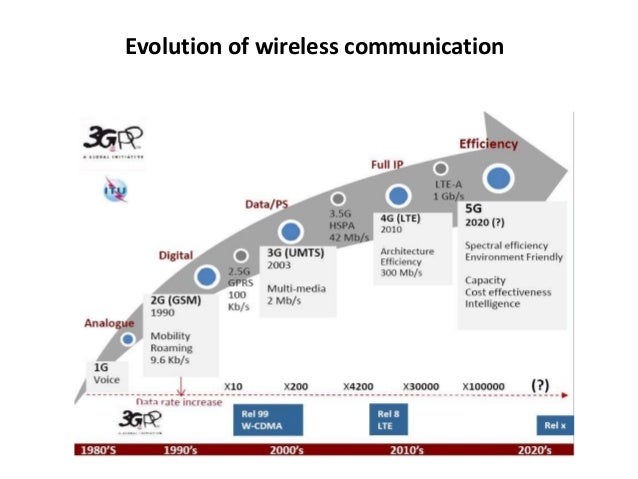
First Generation wireless technology (1G) is the original analog (An analog or analogue signal is any continuous signal for which the time varying feature (variable) of the signal is a representation of some other time varying quantity), voice-only cellular telephone standard, developed in the 1980s.
- Developed in 1980s and completed in early 1990’s.
- 1G was old analog system and supported the 1st generation of analog cell phones speed up to 2.4kbps.
- Advance mobile phone system (AMPS) was first launched by the US and is a 1G mobile system.
- Allows users to make voice calls in 1 country.
Second Generation Wireless Communication (2G)
2G (or 2-G) is short for second-generation wireless telephone technology. Second generation 2G cellular telecom networks were commercially launched on the GSM standard in Finland by Radiolinja in 1991.Second generation technologies are either time division multiple access (TDMA) or code division multiple access (CDMA). TDMA allows for the division of signal into time slots. CDMA allocates each user a special code to communicate over a multiplex physical channel.- Fielded in the late 1980s and finished in the late 1990s.
- Planned for voice transmission with digital signal and the speeds up to 64kbps.
- 2G was the digital handsets that we are used today.
- 2G network allows for much greater penetration intensity.
Second Generation Wireless Communication (2.5G)
Second Generation Wireless Communication (2.75G/EDGE)
GPRS networks evolved to EDGE networks with the introduction of 8PSK encoding. Enhanced Data rates for GSM Evolution, Enhanced GPRS (EGPRS), or IMT Single Carrier (IMT-SC) is a backward-compatible digital mobile phone technology that allows improved data transmission rates, as an extension on top of standard GSM.
Third Generation Wireless Communication (3G)
International Mobile Telecommunications-2000 (IMT--2000), better known as 3G or 3rd Generation, is a generation of standards for mobile phones and mobile telecommunications services fulfilling specifications by the International Telecommunication Union. The use of 3G technology is also able to transmit packet switch data efficiently at better and increased bandwidth. 3G mobile technologies proffers more advanced services to mobile users. Transmission speeds from 125kbps to 2Mbps.
- Data are sent through technology called packet switching.
- Voice calls are interpreted using circuit switching
- Access to Global Roaming
- Clarity in voice calls
- Fast Communication, Internet, Mobile T.V, Video Conferencing, Video Calls, Multi Media Messaging Service (MMS), 3D gaming, Multi-Gaming etc are also available with 3G phones
Fourth Generation Wireless Communication (4G)
4G refers to the fourth generation of cellular wireless standards. The bandwidth and location information available to 3G devices gives rise to applications not previously available to mobile phone users.
Some of the applications are:
Mobile TV – a provider redirects a TV channel directly to the subscriber's phone where it can be watched,Video on demand – a provider sends a movie to the subscriber's phone.,Video conferencing – subscribers can see as well as talk to each other,Tele-medicine – a medical provider monitors or provides advice to the potentially isolated subscriber.
4G is a conceptual framework and a discussion point to address future needs of a high speed wireless network.
5. Fifth Generation (WiMAX, WWWW, RAT)
The 5G (Fifth Generation Mobile and Wireless Networks) can be a complete wireless communication withoutlimitation, which bring us perfect real world wireless – World Wide Wireless Web (WWWW). 5G denotes thenext major phase of mobile telecommunications standards beyond the 4G/IMT-Advanced standards. At present,5G is not a term officially used for any particular specification or in any official document yet made public by telecommunication companies or standardization bodies such as 3GPP, WiMaxForum, or ITU-R. Each new release will further enhance system performance and add new capabilities with new application areas. Some of the additional applications, benefiting from mobile connectivity are home automation, smart transportation,security, and e-books
TYPES OF WIRELESS COMMUNICATION TECHNOLOGIES
CURRENT TRENDS IN WIRELESS COMMUNICATION
TYPES OF WIRELESS COMMUNICATION TECHNOLOGIES
- Satellite:Satellite communication is one of the wireless technologies, which is widely spread all over the world allowing users to stay connected virtually anywhere on the Earth. The Satellites used in this mode of communication, communicate directly with the orbiting satellites via radio signals. Portable satellite phones and modems have more powerful broadcasting abilities than the cellular devices as they have high range, apart from being more expensive in terms of cost, than their counterparts.
- Wireless Networking:Wireless Networking technologies connect multiple computers, systems and devices together without requiring wires or cables: a wireless local area network or WLAN comes under Wi-Fi.
- WiMAX:There are wireless broadband systems that offer fast Web surfing without being getting connected through cable or DSL (Example of wireless broadband is WiMAX).
- Wi-Fi:Wi-Fi is a form of low-power wireless communication used by many electronic devices such as laptops, systems, smart phones, etc. In a Wi-Fi setup, a wireless router serves as the communication hub. These networks are extremely limited in range due to low power of transmissions allowing users to connect only within close proximity to a router or signal repeater.
- Bluetooth Technology:Bluetooth technology allows you to connect a variety of different electronic devices wirelessly to a system for the transfer and sharing of data and this is the main function of Bluetooth.
- ZigBee:ZigBee is a wireless communication standard designed to address the unique needs of low-power, low-cost wireless sensor, and control networks. ZigBee can be used almost anywhere, as it is easy to implement and requires little power to operate.
Future trends and improvements
- Digital technology
- IF Processing
- High Speed DSP Processors
- Reconfigurable Architecture
- Microcell :One to two orders of magnitude smaller than the current cellular system
- Cost will significantly decrease
- Easy and flexible implementation

No comments:
Post a Comment